Deforestation: Why It’s a Business Risk Europe Can’t Ignore
Deforestation is a pressing challenge with far-reaching consequences. For European businesses, it poses direct risks to supply chains, regulatory compliance, and reputation.
While Europe’s forest cover has grown, its consumption drives global deforestation. The EU’s demand for commodities like palm oil, soy, rubber, and cocoa fuels forest destruction in tropical regions, known as "imported deforestation"1.
This global impact has spurred regulatory action. The EU Deforestation Regulation (EUDR), effective December 2025 for large companies, requires proof that products are deforestation-free or face fines up to 4% of annual EU turnover. Addressing these risks is critical for businesses.
What is Deforestation?
Deforestation is the permanent removal of forests, which may be attributed to industrial agriculture, over-exploitation of wood resources, climate change impacts, mining and quarrying and urbanization and infrastructure development.
Here are some deforestation facts:
Globally, forests once covered about one-third of habitable land2.
There has been a significant drop to 48% since 19003.
Between 1990 and 2020, 420 million hectares of forest—an area the size of the EU—were lost4.
While forest cover in Europe has increased in recent years5, it is still estimated that roughly 15 billion trees are cut down every year around the world6.
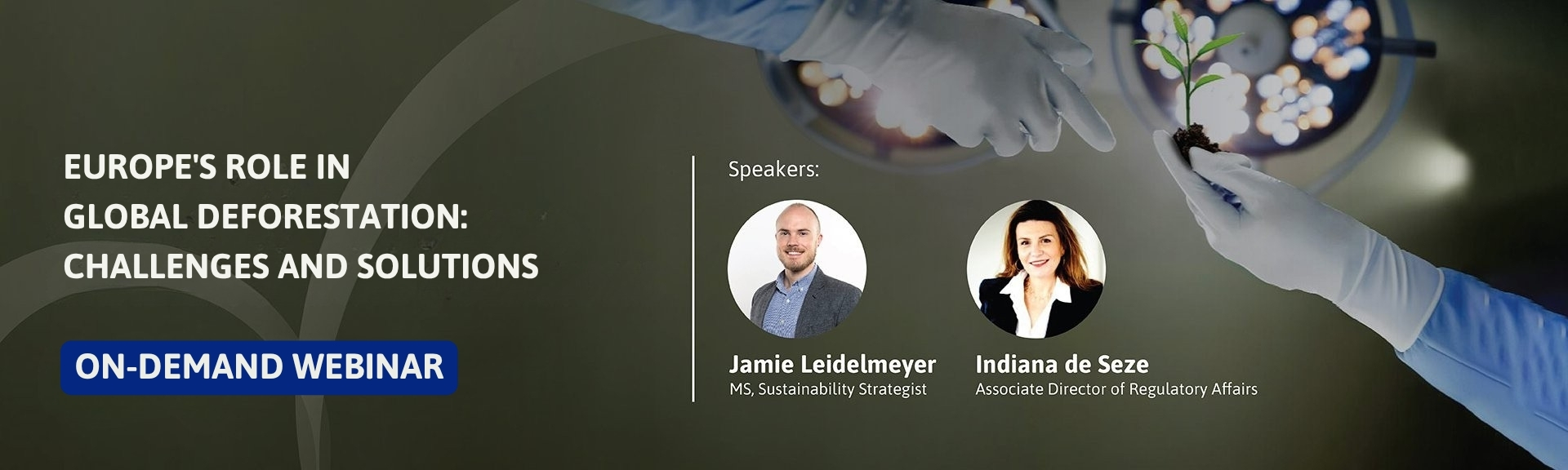
WEBINAR | EUROPE’S ROLE IN GLOBAL DEFORESTATION
Catch our on-demand webinar where our experts unpack deforestation and its causes, Europe's role and practical business solutions.
Europe’s consumption of forest-risk commodities (FRCs) like palm oil, soy, natural rubber and cocoa drives global deforestation. Between 2015–2017, EU imports linked to FRCs caused 1,900 square kilometers of deforestation annually7.
EU Deforestation Regulation (EUDR)8
Adopted in 2023 under the European Green Deal, the EUDR requires businesses to ensure their products are deforestation-free, emphasizing the importance of regulatory compliance.
Timeline and Penalties
The EUDR will first apply to large and medium-sized companies, followed by micro and small enterprises at a later stage. Non-compliance penalties can reach up to 4% of annual EU turnover. Ensure your business follows the EUDR compliance checklist to avoid penalties and align with regulatory requirements.
Turning Risk into Opportunity
EUDR compliance presents both challenges and opportunities. While meeting deforestation regulations requires investment, it enables companies to:
Differentiate with sustainable practices
Build resilient, deforestation-free supply chains
Meet growing consumer demand for ethical products
Success depends on proactive engagement, a thorough understanding of your supply chain and continuous improvement. Transitioning to deforestation-free practices isn’t just about EUDR compliance, it’s about building a sustainable future for businesses and the planet.
Catch Our Expert Webinar
You can now watch our expert-led webinar on demand and gain access to our exclusive whitepaper, a concise guide to the challenges and business solutions surrounding deforestation and EUDR compliance, delivered straight to your inbox.
In this on-demand session, we explore:
The global causes and impacts of deforestation
How Europe contributes to global deforestation through its demand for commodities
Key EU policy measures such as EUDR
Practical steps businesses can take to stay compliant